Thursday, February 21, 2013

It's Hairy Out There!!

Have you ever given any thought to why we use the slang phrase “It’s hairy out there?”  Apparently the British are the ones who originated the terminology of events or experiences being “hairy”.  The meaning, of course, implies that some situation is frightening, difficult or hazardous and “out there” is any area outside the safety of our own home.  The mind rather naturally extends the origins of this definition to the probability that it came from fear of some hairy beast outside.

Beauty and the Beast, 1987-1990

Was there some large, hairy, terrifying beast loose in Europe somewhere in the past?  The legendary children’s story of Beauty and The Beast comes out of France and the stories of the werewolf originated in ancient Germany.  Could this be what the Englishmen were afraid was outside their door?  Or maybe it was something else.


Here on the North American continent, we also have legendary, hairy beasts that terrorize the imagination like the Chupacabra and Bigfoot.  While the official existence of these creatures continues to be debated, there are plenty of individuals who either claim to have seen these creatures or who believe that they exist.

There are also the animals of the fields and forest such as the bear, wolf, wild hog and mountain lion, all hairy beasts in their own rite that can strike fear in the heart of men when they are confronted outside the safety of our homes.  But I have come to believe that there may be another creature that can be added to the list of scary, hairies and that my friends, is the long distance hiker.

It is trail tradition for the male hiker to grow a beard during the length of his hike which at the end of four to six months on the Appalachian Trail gives this hiker the appearance of the rugged mountain man.  At least that is the plan.

For 37 episodes in 1977-78, The Life and Times of Grizzly Adams, based on the true story of James “Grizzly” Adams, aired on televisions and was quite a popular show. Dan Haggerty played Grizzly Adams and many women fawned over the hairy mountain man.  While Mr. Haggerty may wear the beard well and attract the admiration of many women, I’m not sure all our hiking men are so fortunate.  Many end up looking more like Harry from the 1987 film, Harry and the Hendersons.  Scary hairies!
Now, before the men revolt on me here, let me say that I’m a traditionalist at heart and believe that the guys should continue the hair growing habit and finish their hike furry-faced regardless of whether they turn out to be a Grizzly Adams or a Harry.  Beards are making a comeback in fashion right now and who knows, maybe the look will prove to be a good one for you or at the very least it will be good practice for playing the grandfatherly Santa Claus.

For many, this will be the one and only time that they will sport such a look and we all know that shaving on the trail can be quite a hassle.  Who wants to carry a razor and shaving cream around?  That’s extra pack weight and we can’t have that.  And let’s not forget that a beard can provide decent insulation against cold and wind.  So there are some practical purposes hidden behind the hair.

Oh, but what about the ladies on the trail?  You didn’t think I was going to pick on just the men, did you?  Although there are men who preen and fuss over their hair and body builders and athletes who shave themselves smooth, generally speaking, when you think of people who spend lots of time on their hair, you think of women.  I mean, come on, we have to shave, shape and style everything from the hair on top of our heads, to our eyebrows, armpits and everything from our waist down to our toes.  Hair, for women, is a full-bodied issue.

So, let’s start at the top.  The number of ways in which a woman can style her hair are phenomenal, but basically, as a hiker, women will end up in one of three categories—the ponytail or braid, the short cut or the shaven. 
The ponytail, which we know was developed by early cavemen as a handle to carry their chosen mate home, is simple to maintain, can keep the neck cooler and allows a woman to keep her long hair in a manageable fashion. The same can be said for braids which can be worn as a single or as multiple strands.  Hopefully, if braids are chosen, the hiker won’t end up looking like Pipi Longstocking in the morning which could easily be classified as another scary hairy.

The short cut, on the other hand, is another relatively easy hairstyle for maintenance purposes and I kind of like the word association of taking a shortcut on the trail.  Could this be the blue blazer’s preferred style? (Blue blazers are hikers who follow the “blue-blazed” side trails vs. the “white-blazed” official Appalachian Trail.)

Finally, we have the shaven category.  For a woman to shave her head is considered a very brave act by many women.  I have to agree that making the decision to shave your head takes a certain amount of courage.  Of course, this G.I. Jane approach makes for very low maintenance on the trail. I don’t know if men experience the same kind of anxiety that a woman feels when confronted with the buzzing blades of a razor, but I do know that I am not willing to go quite that far.

I spent some amount of time going back and forth between the ponytail and the short cut styles for my hike.  Unlike my two daughters with their thick hair that they can grow down to their waistline, my hair has a very fine texture and has never been longer than a few inches past my shoulders.  For some genetic reason, it just will not grow any longer without disintegrating into a tangled mess of split ends.   

While I generally try to maintain some length to my hair, mostly to please my husband, I typically prefer to go with a shorter cut and finally decided to keep it simple and cut it instead of pulling it back into a ponytail.  I’m not sure if my decision has anything to do with the many hours my mother spent combing the “rats’ nests” out of my hair when I was younger or the reported stories of mice climbing through a hiker’s hair at night in the shelters, but at any rate, I figured I wouldn’t be hunting for hair ties in my gear or waiting for long periods of time for my hair to dry.  

Remember, there are no electrical outlets to plug in the hair dryer and we certainly won’t be carrying all the mouse, gels, sprays, curling iron or brushes that a lady may use on a typical day.  So, with just a little of two weeks until I head out for the trail I took the plunge and got it cut.

All of this hairstyle talk may end up being a very moot point though since most of the time I will be wearing one hat or another on my head.  I am literally taking two hats, one to keep my head warm and the wind out of my ears and the other to shade my eyes from the sun and just because I like to wear a hat. 

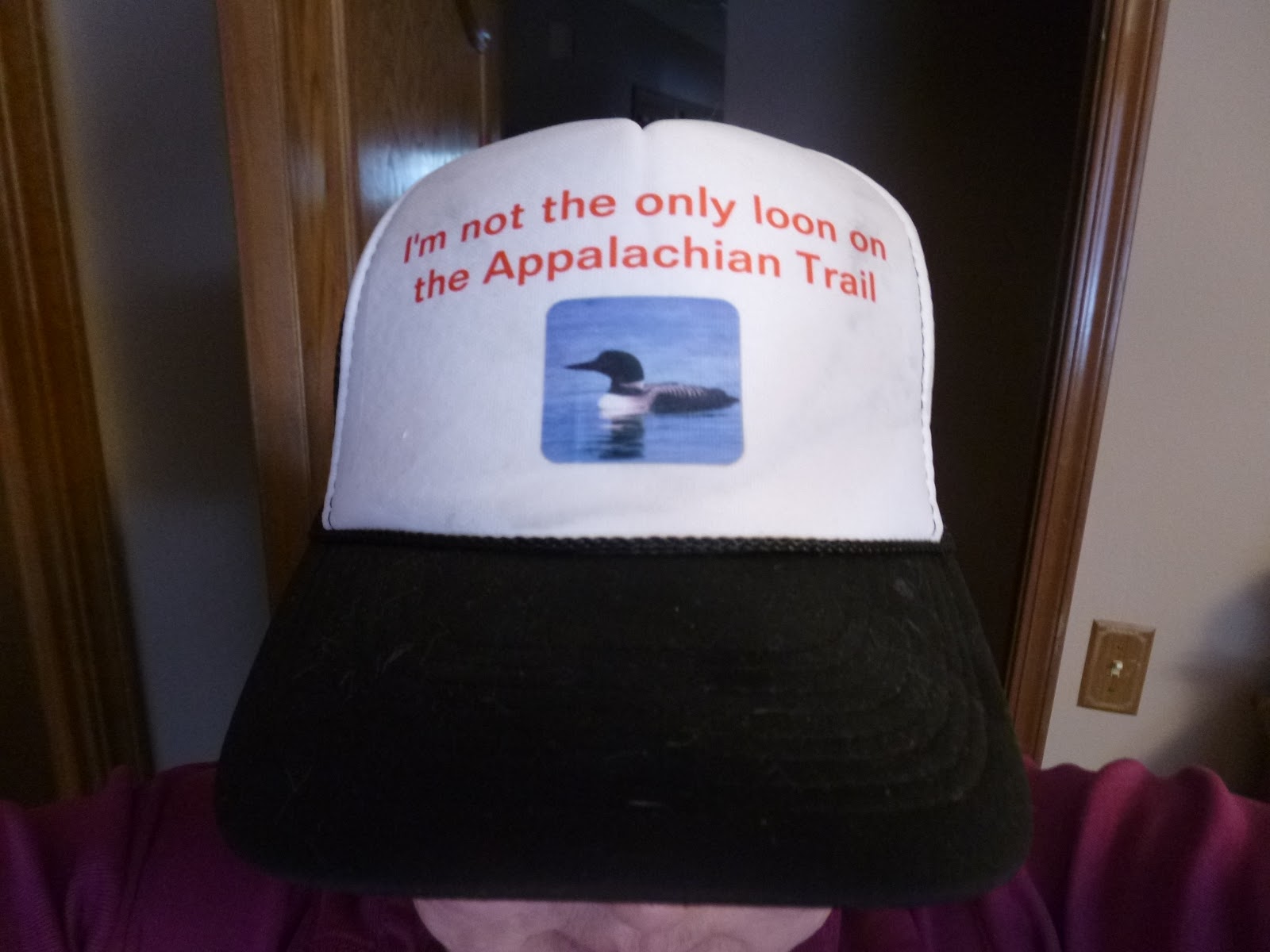
As a matter of fact, I had a special hat made just for this hike.  The cold weather beanie does a great job but I’m hoping to not have to wear it very often.  No, the hat I prefer to have on is my trucker ball cap. Typically, I don’t wear this type of ball cap, but the mesh on the back side of the cap will help to keep me a little cooler and besides, it reminds me of my grandfather who wore this style of hat for years.  Either way, these hats will definitely help cover up the “bad hair days."
Victor Melling in the movie, Miss Congeniality, while prepping his beauty pageant contestant (ah-hem, that would be scholarship contestant) makes   the remark, “Eyebrows, there should be two” and I’m willing to wager money that the set of tweezers carried by most every hiker for the supposed purpose of the removal of ticks and splinters will be used by the women on the trail, along with their emergency signal mirror, to maintain the shape of their eyebrows.  For those of us in the slightly mature crowd, I’m sure we can find some other plucking uses for those tweezers as well.  I, for one, have no intention of trying to compete with the men in the facial hair department and plan try to keep my menopausal moustache and grandma goatee under some form of control while out there.  No, I have no desire to become the bearded lady and begin a career in the carnival after my hike.

As for the rest of the body hair, namely the pits and legs, most women hikers “go European.”  I don’t honestly know that the American assumption that European women don’t shave their pits or legs is true, but it certainly is what most Americans believe and have been told.  This shouldn’t be surprising as again, shaving in the forest can be a bit of a hassle. I’m sure most women hikers will be looking for those opportunities to catch a shower at a hostel or hotel when they can tame the wild, hairy beast they have become and once again, if only for a short while, feel like a lady.

So, as a non-hiker, if you happen to come across a large, hunch-backed, smelly, hairy creature coming out of the woods in the early evening hours please don’t freak out and report to the police that you’ve spotted a Big Foot.  In all likelihood, it’s just a long distance Appalachian Trail hiker coming into town for an evening meal, a shower and a shave, because it really is hairy out there.


Gotta love this one!!


Tuesday, February 12, 2013

Lady of Luxury


“Son, calling me ‘Sir’ is like putting an elevator in an outhouse; it just doesn’t fit.”

                                                                                    -- Emmet, Roadhouse, 1989

 Anyone who knows me can tell you that I have never been mistaken for a supermodel and I’m not exactly what we call a “girlie-girl”.  I didn’t enjoy playing with dolls as a child, never could get used to carrying a purse and make-up rarely graces this face.  No, I was the girl you’d find out on the ball field with the boys, wandering through the weeds examining bugs and wildflowers or digging in the dirt for fishing worms.  Most summers my legs looked like I’d been in a fight with my razor from all the cuts I’d have from running through the briars and the rash of sores from itching at poison ivy.  Yep, I was tomboy through and through or as my friend, Sonya says, a real Dirt Barbie.

Now, I’ve always admired those women who seem to have flawless beauty, graceful moves, the lovely clothing and fancy shoes, but I just don’t fit into that category.  Most attempts at trying to wear make-up or dressy clothes just leave me feeling uncomfortable and irritable.  It feels like trying to wear someone else’s skin.  My husband once saw me attempt to put on a pair of high heels in a shoe store and promptly remarked, “Get out of those before you hurt yourself!”  See, I wear a size 11 or 12 woman’s shoe depending on how they’re made and at 5’8”, I run to the taller side of most women’s sizes.  Add to that, the extra pounds I carry around and it doesn’t take much of an imagination to see why I’m out of the running for Miss U.S. A.  So, give me a pair of denim jeans, a cotton T-shirt, sneakers or flip-flops and I’m good to go.  
 
 
However, these clothing choices, while acceptable for a short day hike, are not going to work on a long distance, multi-month hike.  While years ago, everyone went hiking in denim jeans and cotton shirts, now we know that these are not good fabrics to protect you from hyperthermia situations which can occur anytime of the year.  A hiker on the Appalachian Trail is especially prone to this danger after walking along rain-soaked trails in those notorious thunderstorms that are so common in the spring and summer months.  So, I had to invest in a new wardrobe for this trip and clothes shopping is not one of my favorite activities, but I was in for a bit of a surprise.

For those of you who have been involved in sports or physical training of any kind over the last 5-10 years, I’m sure you are quite familiar with the current active-wear line of clothing, but for someone like me, who hasn’t had a gym membership or participated in any organized sports, aside from bowling, for decades now, these apparel choices are all new to me.  Terms like “wicking fabric” and mid or base layers are new to my vocabulary.  Companies like Under Armour, The North Face, Patagonia and Columbia have joined the ranks of the old school names of Nike, Adidas and New Balance.  Maybe they have even been around longer than I realize, but these brands are not normally included in my clothing purchases.  And of course, there is that taboo fabric of spandex that should never be stretched over some figures; mine included.

Well, after educating myself and receiving a lot of advice from experienced hikers, I have overcome my ignorance and am thrilled with my new hiker wardrobe.  It turns out that while there may be new terms for the material and there may even be some technological advances in the strength or durability of some of the fabrics, most all of this “new” athletic gear is nothing more than a combination of nylon, polyester and spandex blends.  Here’s a breakdown of my very fashionable hiker attire:

Pants:  I will be sporting Cabella’s Guidewear GXII convertible pants that are listed as 100% nylon performance fabric online and the tag reads 100% nylon shell with 100% polyester lining.  As convertible pants, the lower leg zips off to become a pair of shorts and they are equipped with a side leg zipper from the hem line to about mid-calf so that the pants can be converted without having to remove muddy boots. 

Shirts:  The shirt that I will wear is by Columbia and is listed as 100% polyester double piqued fabric with Omni-wicking technology.  Ok, yeah, sure….it’s a polyester shirt, very light and very comfortable and I love the color…teal for my first one, with a mint green one in reserve at home.  I am also carrying a spare shirt that is a Patagonia capilene 2 made of 100% polyester to wear if I need another insulating layer or in case my main shirt is wet, in the wash, etc.

Socks:  Two layers here.  The first is the Injinji Performance Toesock Liners which are supposed to help with moisture wicking and prevent blisters.  They are made of 75% Coolmax, which is an enhanced polyester fiber, 22% nylon and 3% Lycra, which is another word for spandex.  The second layer is the Smartwool PhD crew sock of 72% Merino wool, 26% nylon and 2% Elastane.  I will be carrying 2 pair of sock liners and 3 pair of Smartwool socks. 

The Unmentionables:  Ok, so I’m mentioning them anyway.  I’m doing something in this department that I never thought I would and am wearing men’s Adidas Climalite boxer-briefs with an 8” inseam.  These are surprisingly comfortable and are made of 91% polyester and 9% spandex.  The 8” inseam helps prevent thigh chafing and the material will wick away moisture.  There’s nothing like a good case of chafing to slow a hiker down.  These briefs are more like biking shorts than underwear and can be used for swimwear as well.  

As for the upper half, I will be wearing a good ole Fruit of the Loom full back, colored (either dark blue or a striped multi-blue & white) sports bra.  While this item is the only thing in the wardrobe with 95% cotton and 5% Lycra/spandex, it serves its purpose well, is comfortable and will double as a swimming top when needed.  Although, if and when I decide to dip into the water for a cool down and some relaxation, I don’t think it will be in a very public arena and I wouldn’t count on getting any pictures posted online either.  Some images just aren’t meant to be implanted into the brain.

Long underwear/thermal wear:  Columbia Omni-heat reflective thermal wear (pants and shirt) also made of 85% polyester and 15% Elastane/spandex.  My son says I look like I work at SeaWorld when I put these on, but this material is cool just to look at with its space-aged, shiny, silver lining that is supposed to reflect your body heat back to you.  Think of wearing an ultrathin car windshield shade covered in polyester.

My other cold weather clothing is all outer wear items such as a Patagonia down jacket, a Mountain Hardware fleece hat, a Marmot Trailrunner windbreaker jacket (100% polyester), a set of leather gloves and a pair of Thermasilk glove liners made of 100% silk…yes, you heard me right, silk.  I have never owned anything made of silk, which in my mind, is the ultimate in luxury fabrics.  On top of the glove liners, I also have a silk sleeping bag liner for inside my big, fluffy down sleeping bag which can add another few degrees protection in the cold and also will serve as my summer sleeping bag on its own. 

Down, there’s another item that is new to my wardrobe.  The only down item I have ever owned is my down pillow.  Now, while out in the wilderness, I’m going to have the pleasure of wrapping myself inside this wonderfully full, down cocoon every night for the first couple of months.  And around camp in the evening, I’ll have my Patagonia down jacket to insulate my body.  I don’t know about you, but I get a real sense of comfort when I wrap myself inside a nice, warm, soft blanket and these down items definitely fit the bill.


So, here I am, about to embark on probably the dirtiest, smelliest and most rugged trip I will ever take, one that I thought would appeal to my tomboy nature and instead of durable denim and my common cotton tee, I’m going to be wearing silk, polyester and nylon; all materials that are soft, slippery and the most sensual of fabrics.   I keep shaking my head in disbelief and trying to make sense of all of it.  I wonder…should I pack a little black dress and heels too?  Nah, that might be taking things a bit too far, but I sure do like this luxurious new wardrobe.


Monday, January 28, 2013

Potty Perplexities

Sunfish Pond Privy, New Jersey
When my husband and I were first getting to know one another in 1987, I remember a specific comment he made while we were comparing our childhoods; “You’re kidding me, right?  You come from Pennsylvania, one the original thirteen colonies, and you grew up using an outhouse?!”  My dear Los Angeles, born and bred, city-boy just couldn’t wrap his head around the idea that outhouses were still in use in areas of this country that he considered modernized.   He was a victim of our ability to attribute our personal experiences to a wide area of real estate that aren’t always true and often result in stereotyping.  He had only traveled to areas of Pennsylvania that were cities or large towns and therefore, was unfamiliar with the more rural areas of my home state.

You know how it goes; you visit Albuquerque, New Mexico to attend the fall Balloon Fiesta and are introduced to your first green chile cheeseburger.   You notice that rarely do you have a meal that you aren’t asked by your waiter, “Red or green?”  When you go back home, you tell everyone how New Mexicans eat chile on everything, not realizing that there are actually many New Mexicans who don’t care to eat chile at all.  But your experience has manifested in an assumption concerning New Mexicans and that is why we all know that Texas is loaded with gun-toting cowboys, the South is full of rednecks, everyone in Oregon is either an environmentalist or lumberjack and everyone in Maine eats lobster.   Of course, when our stereotypical perceptions suddenly are shattered by realities, it comes as quite a shock, hence, my husband’s surprise to learn of my outdoor bathroom habits.

Yes, I grew up using the outhouse on a regular basis.  My childhood home in the Appalachian Mountain foothills had a well that was going dry, so although the house had indoor plumbing, we conserved what little water we had and used the outhouse.  Exceptions were made for night-time nature calls, especially in the winter.  No one enjoys having to don a coat and boots over your pajamas to wade out into the snow and cold with a flashlight.  And our home was not the only place in which the outhouse was in regular use.

From September, 1978 through May, 1979 I had the privilege to live with my grandparents.  One of my chores while living there, was to “empty the buckets”, as Grandma put it.  My grandparents didn’t have ANY indoor plumbing, so the outhouse was used almost exclusively.  Again, nighttime was the exception, but without a flush toilet available in their home,  you would use the bucket sitting in the corner of the bedroom.  This baked enamel metal bucket with its matching lid and  wire handle was your indoor toilet or “chamber pot” if you prefer the more sophisticated term.  To us, it was just “the bucket” and it would be taken out in the mornings and emptied into the outhouse, rinsed and cleaned, and placed back in the bedroom with a roll of toilet paper by its side to await the next nighttime deposits.

The outhouse in use at their home at that time was the second one that had been constructed on the property.  I don’t know exactly why the older one ceased to be used; I had always assumed it was full, but I do remember how proud my grandfather was with the construction of the new one and how often he joked about the “improvements” that the new outhouse contained.  Yep, it was a fancy one!  It came complete with aluminum siding, a concrete floor, a real house door with a window and an actual toilet seat attached to the cut out hole.  It sure beat the old, dark one next to it that was covered in asphalt roofing shingles.

In the fall of 1985, my grandparents did eventually install indoor plumbing in their house as it was becoming harder for them, as the aging process took its toll, to haul water to use at the house.  Still, it wasn’t uncommon even after the installation to walk out to the backyard and discover Pappy “watering the weeds” at the edge of the property.  While, this may seem shocking or disgusting to some people, it was all just part of life for us and as natural for him as any creature that relieves itself in the woods.

Since those days, my outhouse use has been fairly limited to the occasional campground, roadside rest area or fiberglass port-a-potty that has been placed where other facilities are not available.  For most of us, this is the extent of our exposure to the once commonplace outhouse or privy.  But as I prepare to set out on this hiking adventure, I find myself once again facing the more primitive methods of relieving myself. 

There are 266 privies along the route of the Appalachian Trail most being located near one of the shelter or hut facilities provided for hikers.  That’s an average of 8.2 miles between structures.  As with old barns, churches and lighthouses, outhouses are often shown in photographic art as a revered piece of Americana.  There are some unique and interesting outhouses along the way such as the open-air, throne style privy at Moose Mountain Shelter in New Hampshire (shown here), “The Lorax” privy north of Damascus, VA with the entire Dr. Seuss “Lorax” story written on the walls inside, the two-seater with a backgammon board painted between the seats and the five-sided Penta-Privy.  I look forward to getting some pictures of some of these unusual pieces of American art.

There is also some opportunity to use regular flush toilets while passing through town or near the more populated recreational areas of the trail, but these trail privies provide the majority of a hiker’s restroom opportunities.  Or maybe I should say, the opportunity for a more civilized manner of relieving oneself, for there is another option and that, of course, is the all-natural-squat-in-the-woods.

While I have often been surprised by my fellow hikers actually spend time arguing over whether or not to pack out toilet paper, I can’t help thinking that we are providing proof for those outside of the hiking community of our “craziness.”  I mean, really, what sane person actually sits around debating the proper way to take a crap in the forest?  Well, the truth is, not just hikers, but environmental research individuals and many persons who willingly donate their time and effort to the maintenance of the trail and its facilities spend time discussing such matters.  While Bambi, Bullwinkle and Yogi can get away with letting it drop where it may, the concentration of humans along the trail make this drop-and-go method a bad option.  Consider this fact alone, there are 2-3 million visitors that hike some portion of the Appalachian Trail every year.  Now if each one of these persons was to squat leaving behind approximately 1 lb. of fecal waste within 20’ of the trail, there would be a pile of doo-doo at an average of every 4 feet from Springer Mountain in Georgia to the peak of Mt. Katahdin in Maine.  That sure would make for a lovely hike, wouldn’t it?

Now, of course, most day use or even weekend hikers are going to use the privies most of time.  But what about these long distance hikers who are out there for months at a time?  Are they actually able to “time” their restroom breaks or “hold it” until they come across the next outhouse?  (I did hear one hiker that bragged of such a feat.)  At the very least, I’m sure that at we all share the morning need to void upon waking.  And I’m confident that most all of us were also trained from our youngest days to go relieve ourselves before going to bed.  So if a hiker has camped at or near a shelter along the trail, then I’m sure that the privy will again be used with frequency, although the official rules strictly discourage the practice of using the privy for urination purposes and request that you limit privy use for the more weighted bathroom matters.

But what if you aren’t camped near a shelter with a privy?  And what about those night time calls?  Those of us over the age of 40 are quite aware that what used to be a rare occasion is now a regular nightly ritual.  Oh, I can hardly wait for the crystal cold night that finds me warmly cocooned in my down sleeping bag when the urge hits and I must expose myself to the wintry world outside as steam rises from my own personally created hot spring.  As I have done in previous times, I will focus on the stars above and the clarity of night sky and convince myself that any discomfort is worth the reward of such a wondrous site.

Of course, there is the option of creating your own version of a chamber pot in your tent.  One lady hiker friend is planning on using an empty peanut butter jar for just such occasions.  And why not?  If hospital labs can expect us to pee in those little specimen cups, then a peanut butter jar is a large throne by comparison. 

Personally, I’m considering an actual pot to use as my nightly chamber pot.  I’m carrying a 2 liter cooking pot with me which is much larger than most hikers carry and if I line it with a gallon sized plastic bag, it will make a suitable chamber pot complete with a lid.  Oh, I can hear you all now…ewww!!!  But I assure you, my pot will be totally sanitized before I eat out of it again, but even if it wasn’t, I wouldn’t necessarily be harmed by any residual urine.  Don’t you know that over 3 million Chinese are reported to drink their morning urine every day and that this is an ancient yoga ritual that is supposed to promote health?  Not exactly my cup of tea, though.

Anyway, I guess I should mention the actual Leave No Trace rules for disposing of human waste while hiking in the backcountry or for anyone who is out camping without privy facilities available.  For the deposit of number 2, we are instructed to dig a cat-hole 6-8” deep, ironically the same depth as the famous orange trowel blade used to dig the hole, and approximately 4-6” wide.  Do your business and clean up with a small amount of toilet paper or, for the truly rugged experience, a handful of leaves and deposit these in the hole.  Stir with a stick, leave the stick in the hole and replace the dirt, burying the contents.  For added security against curious animals that may dig up the site, place a rock or log across the hole.  Also, if you feel so inclined, you can pack out your used toilet paper instead of burying it and you are not to burn it.  If you are near a privy, use it, but, as stated earlier, only for number 2.  As for urination practices, we are instructed to urinate on rocks if at all possible and not on plants as animals will eat the leaves of the plants to get the salts left behind.  Also, you can pour water over your urination site to dilute it.


Now, I will be honest with you, I know a lot of people who would think that these rules are created by a bunch of hyper-environmentalist type people and that they are way too detailed.  I can sympathize with their point of view, however, after seeing the pictures and hearing the stories of areas that are so strewn with toilet paper and piles of human waste, I wonder if it’s not a necessity to make such rules.  I’m appalled at the disregard some people have, not only for our natural environment, but for their fellow man.  It makes me wonder about just how civilized some of us really are.  And we have to keep in mind that although the critters crap in the woods without digging cat-holes and burying their waste, they also don’t all congregate in a narrow strip of land to do their business but are scattered over a much great area.  So, unlike the animals, we must act more civilized and utilize ways to dilute our impact on the forest.
Thistle Hill Privy, Vermont
Yes, my husband learned early on in our relationship about my outhouse days.  He also learned that I had never lived in a house that had a dryer; I had never done more than heat water or make popcorn in a microwave; and that the majority of the meat I ate growing up was obtained not in a store, but through the annual rituals of hunting, fishing and slaughtering of animals raised for meat.  After his initial shock at such uncivilized and ancient behaviors, he jokingly and lovingly called me a real “Hill-Billy Hick” and it is a term of endearment that I have proudly carried ever since.  Now his concern is that after 25 years of trying to “civilize” this Hill-Billy Hick, when I return from six months of doing my business outside, he’ll have to housebreak me all over again.

Wednesday, January 9, 2013

Mountain Melodies

For nearly four decades, Casey Kasem hosted the American Top 40 radio show which was a countdown of the most popular songs in the country.  One of the signature characteristics of this weekly broadcast was the long distance dedication, a segment in which Casey would read a letter highlighting a significant relationship between the author of the letter and another individual and which ended in a request for a specific song to be played in honor of that relationship.

Although I don’t remember any of the specifics from these letters and long distance dedications, what I do remember is the sensuous tone of Casey Kasem’s voice as he held his audience spellbound by the story in the letter.  It was if a hushed silence had fallen over all America and thousands of people were sitting around the glow of the radio dial breathlessly listening to the story unfold.  I would imagine that we, the audience, would collectively wipe away the single tear rolling down our cheek on the sad stories or would share the sigh and smile that accompanied the sweet and loving story.  Then the song would play and we would be left alone in our thoughts and eventually, through the music, be brought back to reality and out of our emotional trance.

Music is one of those universal cultural elements.  We use it to celebrate and to mourn.  We use it to worship and to protest.  We use it to give our opinions and to ask questions.  We use it to tell stories and to record our history.  Our experiences and emotions have an impact on music and music, in turn, has an impact on our experiences and emotions.  Just as the scent of a freshly cut lawn can carry us back to memories of summer days, music also, has the ability to transport us to a time and place in our past complete with all the emotions and visual images that play across the screen of our inner mind. 

Why one particular song will attach itself so strongly to a memory and another does not I cannot explain and will leave that question to the neurologist and psychologist to answer.  But, for most of us, the association of song and sentiment are a fact of life that we both embrace and resent.   For we know that the music, randomly playing on its own, can arbitrarily lift our spirits or send us into an emotional pit of despair and sadness.  Therefore, we often control the songs that we will hear to control our own emotional state.  Such is the case for the long distance hiker in making song selections that will be carried while on the trail.

Now, first of all, I must say that not all hikers carry music on the trail and some find it downright offensive to bring this artificial source of sound into the natural environment that they intend to experience.  General trail etiquette maintains that if you bring music on the trail, that it is to be confined to the range of your own hearing or at the very least, that you give consideration to those who wish to enjoy an unaltered natural state the courtesy of curtailing your music until you part ways.  Also, with the long distance hiker’s concern for the amount of gear they must carry, the means to play the music of choice is another matter to be given serious thought.  Do you really want to carry around another piece of equipment that needs batteries or that bad weather could destroy?  Is having music on your hike worth the added weight and worry with regard to loss, damage or theft?

At first, I had no intention of taking music with me on my hike.  I enjoy listening to music as much as the next person, but I very rarely play music when I am out camping.  We are so inundated with man-made sounds in our day to day lives, that I usually appreciate the break from it all when I’m outdoors.  The birds provide quite a bit of music as do many other elements of nature such as the babbling brook, the wind whispering through the pines or the chattering squirrel upset with my presence.  But there is a lot of difference between a few day camping trip and six months on the trail. 

What would it be like to not hear any music for six months?  Could I do that?  Yes, I could, but do I WANT to go without it for that long?  My singing from memory is only going to satisfy me for so long before I’m sick of the sound of my own voice, then what?  Maybe hearing the occasional music over the speakers in a store, from a passing car or from someone else’s device or instrument would be enough.  Maybe, but it could just as easily be a style of music or song that causes me to wish I hadn’t heard it as one that I might enjoy.  What would be the benefits of bringing music along with me?  Well, for one thing, I could use the music for motivation, to increase speed or inspire myself when I get tired.  I can use the music to make emotional adjustments, ward off depression and loneliness or just to brighten the fifth bleak, rainy day of the week.  I can use the music to break up the monotony of picking them up and putting them down day after day after day.  I can use the music to celebrate accomplishments and to worship my Creator for the beauty of the creation around me.  Yes, the benefits could far outweigh the negatives. 

So, once again I find myself acquiring a new piece of technology, at least new to me, for my trip.  I have purchased a Sony W Series MP3 player with 2 GB of memory.  After doing some research, I selected this item because it does not have a screen like most MP3 players which will allow the battery to last much longer.  Also, this is a model designed for runners and is worn over the ears rather than carried, clipped or strapped onto the belt or body.  With a combined weight of 1.9 ounces for the player and USB charging cord I don’t think the weight will be an issue and I have 320 songs recorded to the memory with room for more.  I’m sure that many people and most of the younger generation would opt for a device with more storage and features but I’m quite satisfied with the simplicity and capacity of my selection.  It certainly is an amazing upgrade for an old school gal like me who still has cases of cassette tapes in the house.

One of my sons often critiques my taste in music by saying that I quit listening to new music thirty years ago.  While his opinion is a bit extreme, there is an element of truth to it; I prefer listening to music from the 1950s through 1980s over most music produced today.  Of course, this is a common generational issue, but I do have a hard time relating to some of the music of today and a lot of it I find just plain distasteful.  Of the modern genres, I lean toward contemporary Christian or country, but outside of that, most of the time, the older music will most often be playing on my truck radio or on the stereo in the house.  The tunes fit like a pair of old comfortable shoes and I can actually sing along with the lyrics.

While I sincerely hope that no one on the trail hears me singing out loud as I’m afraid they will think there is some critically injured animal in the area, I suspect that over the course of nearly 2,200 miles, I will let my guard down and at some point, this warbling walker will be thoroughly embarrassed by the discovery of my audience.  Over the years, to prevent my sad solos from being heard or to prevent being ticketed for noise pollution, I have gotten quite good at lip-syncing.  Of course, those skills are enhanced with my ensemble of air guitar, air drums and various other air instrumentals and a whole range of struts, bobs, glides and weaves that don’t resemble anything that could be mistaken for graceful dance moves.  I can only hope that I don’t scare some poor unsuspecting fellow hiker into calling 9-1-1 because he thinks I’m having a seizure and may require immediate medical attention when he sees me bee-bopping down the trail.

Lots of good music is designed to make you feel like moving your feet and in this case, that’s exactly what I want to happen.  The songs I have on my MP3 player have been specifically selected to meet one of several criteria.  Does the song give me a good or happy feeling?  Is it a song that I enjoy singing?  Does the song “pump me up” and give me energy or motivate me to keep trying or to go on?  Does the song remind me of a favorite place, time or person that makes me smile?  Is the song specifically related to the mountain environment?  Does the song fit the awesome views I anticipate seeing?  Does the song express my grateful heart for having this opportunity or is it an expression of thanks to my God for his creation?  Does the song have anything to do with rain, thunder or storms? 

I’m sure with the information I’ve provided so far, you can probably guess some of the titles in my MP3 library, but I will confirm your suspicions and say yes, Rocky Top, Rocky Mountain High and Rocky’s, Eye of the Tiger are all included.  My 30 year class reunion will be held in August and I should be somewhere in northern New England at that time.  While I haven’t decided if I will rent a car and drive back down to PA for the event, I have included the Statler Brothers’, Class of ’57 to remind me of all my classmates.  They’re Coming to Take Me Away, Betty Davis Eyes and The Locomotion each reminds me of special people in my life, namely two of my girlfriends and my mom.  Of course, the ultimate woman’s motivational song, Gloria Gaynor’s, I Will Survive made the list.  Chris Tomlin’s, I Will Rise and Casting Crowns’, Voice of Truth lift me up.  How Great Thou Art has always been one of my favorites and with the lyrics of the second verse being:

                When through the woods and forest glades I wander
                And hear the birds sing sweetly in the trees,
                When I look down from lofty mountain grandeur
                And see the brook and feel the gentle breeze;

how could I leave it out?  And, of course, my family would be in shock if there wasn’t a plethora of tunes included from the happiest place on earth, Walt Disney World. 

It may be an odd mix of music, but as Francesca Battistelli says in her lyrics, I’m free to be me and this collection makes up my own form of a long distance dedication; it’s dedicated to all the relationships I’ve had over the years of my life including my relationship with the beautiful Appalachian Mountains.  So, I will follow Casey Kasem’s advice, “Keep your feet on the ground and keep reaching for the stars" while I do The Hustle across the heights of Appalachia.

Tuesday, January 1, 2013

Time Travels

Most people have heard the passage from Ecclesiastes that states, “There is a time for everything, and a season for every activity under heaven:” (Eccl 3:1 NIV), but fewer are familiar with another passage in Ecclesiastes that says, “Don’t long for ‘the good old days.’  This is not wise.” (Eccl 7:10 NLT)  At the beginning of each new year, we often look back as well as forward, but looking backward while trying to move forward can cause one to stumble or fall or, at the very least, slow one’s progress tremendously.

When I was young, it was a really big deal to stay up until midnight to bring in the New Year.  Our family of four had a tradition of opening a large jigsaw puzzle of about 1,000 pieces and challenging ourselves to complete it by midnight.  We ate snacks, watched television or listened to music while taking turns working on the puzzle.  Sometimes we beat the clock and sometimes not.  This tradition ended with my parents’ divorce and, aside from a pair of parties in my military days that involved too much drinking, so did my celebrating of New Year’s Eve.
 
For a long time, I found that the turning of the year made me very melancholy, though I always tried to hide these feelings from everyone.  All the year-in-review type of programs got me thinking about my own personal year in review.  Somehow, my end of the year countdown seemed to have me making a list of all the things I hadn’t accomplished or hadn’t acquired.  I would think about all the people who had passed away, whether they were loved ones I had lost or celebrities who somehow had an impact on me.  All this remembering seemed to do was lead me down a path of pessimism and grieving that didn’t make me feel much like celebrating.

Maybe this seems strange to the many people who enjoy dressing up and going out to a New Year’s Eve party.  They eat hors d’oeuvres, dance and drink the hours away until it’s time for the champagne toast at midnight.  The confetti falls, the party horns blow, kisses are shared and then the lyrics of Auld Lang Syne, themselves reminiscent and somewhat somber in nature, bid farewell to time gone by.

While I’m not a teetotaler, I’m also not one who believes alcohol is necessary to have a good time.  I lack skill on the dance floor and often find that the music played in most establishments is amplified to such volume that you can’t have a conversation with anyone who isn’t screaming within a foot of your ear.  Consider me old and boring if you must, but I don’t find that environment very pleasant and I left behind the clubs and party scenes of youth years ago for a more mellow and responsible lifestyle.

Some of that responsibility involved raising children.  Most of us have been through the New Year’s Eve with a child who begs to stay up until midnight only to watch them fall asleep an hour or so before the ball falls.  Sometimes we wake them up saying, “It’s time; it’s the New Year.”, only to have their sleepy little head nod off again without any real comprehension of the event.  We cover them up and let them sleep on the couch for the night or carry their little bodies off to bed.  We’ll be up to make breakfast for those same tired bodies in a few more hours, so there’ll be no sleeping off last night’s indulgences for us.

Before long, the kids are grown and on their own.  The only party horns blowing in your home are the resonating nostrils of your spouse in the recliner next to yours.  You watch rerun marathons on television and change the channel just before midnight to watch the young revelers in Times Square countdown the seconds as the ball drops.  You wake your spouse with a soft “Happy New Year, Dear.”, and give him a kiss and head to bed while tripping over the dog that is afraid of the popping fireworks outside.  Another new year arrives regardless of the celebration or lack thereof, because time travels in but one direction. 

For the first time in quite a while, I am actually excited by the turning of the calendar.  It’s 2013!  I’m going to hike the Appalachian Trail in 2013 and now it’s finally here!  I’m now one day closer to my goal.  Yes, time will continue moving forward as it always has and I would be wise to learn the lesson that it teaches…keep moving forward.  That is how we will arrive at the next New Year, by moving forward; minute by minute, day by day.  It’s how I’ll get to the top of Mt. Katahdin; step by step; day by day; moving forward.

HAPPY 2013!!